Showing posts with label Boraginaceae. Show all posts

Friday, March 28, 2014

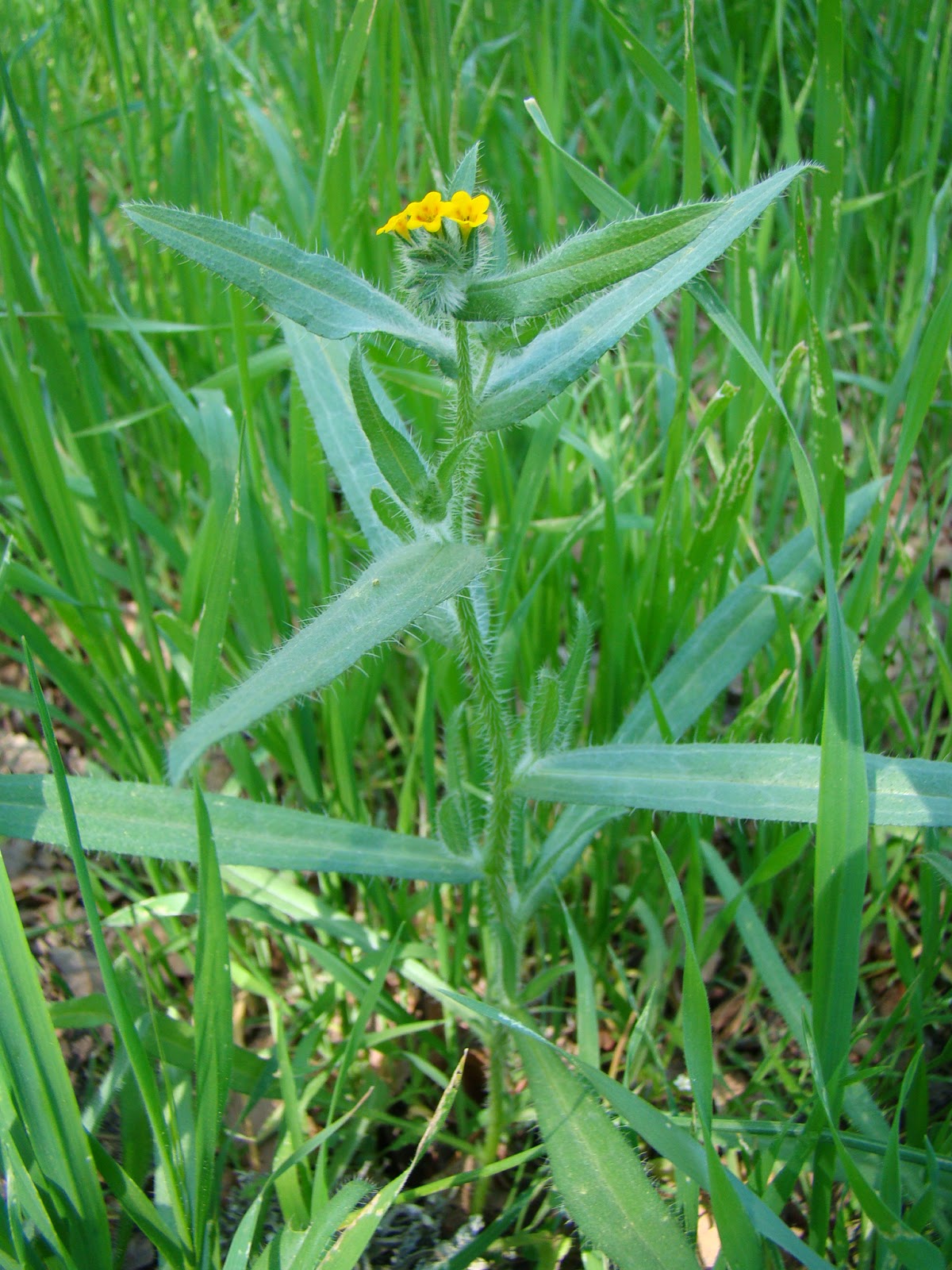
Menzies' Fiddleneck


 Menzies' fiddleneck

Amsinckia menziesii is a plant of Borage (Boraginaceae) family that right now is blooming in the oak grove where I sometimes go for a walk. They are all over the meadows. Fiddlenecks have small but bright yellow flowers with reddish spots on each petal.

Close up of the fiddleneck flowers

When the plant matures, the upper part of the stem curves, hence the name fiddleneck. The plant starts as a rosette but then grows into erect stem with alternate leaves. Both stem and leaves are covered with coarse hairs, which is typical for borage family.

Fiddleneck inflorescence

Fiddlenecks were one of the first flowers to appear in the meadows and it still doing well. The genus Amsinckia have several species but they are hard to tell apart. Some native Americans used this plant for medicinal purposes.

Friday, July 6, 2012

Forget-me-not

 Forget-me-not (Myosotis sylvatica)

Forget-me-not , also known as myosotis, which means mouse's ear in Greek is a rather short plant with small but showy little blue flowers. It is quite common in the redwood forest and other places as well. The species of the forest most probably are Myosotis sylvatica.

The stem is fuzzy.

Fuzzy stem of forget-me-not

The flowers are usually in clusters

Close-up of flowers

Interesting thing is that the name is similar in other languages as well. It is supposedly came from French ne m'oubliez pas. The plant belongs to borage family (Boraginaceae), same as already familiar to us borage, salt heliotrope, cryptantha, comfrey, fiddleneck and many others. 

Saturday, June 30, 2012

Borage

 Borage

Borage is a rare and beautiful plant cultivated for its medicinal properties. It has bright blue flowers reminiscent of flowers in the nightshade family, only bigger. Yet, borage belongs to Borage family (Boraginaceae).

Borage flower close-up

Borage stems are hairy. The flowers are usually bright blue. The plant is easily recognized by its general appearance.

Among the medicinal uses, borage oil is quite famous (extracted from seeds, a good source of Omega-6 acids). The plant is also used to treat respiratory maladies. Borage is reputed to be edible and is supposed to taste like cucumber. I tried it and it does have cucumber flavor but very, very faint. The texture is not particularly palatable as stems and leaves are hairy. Borage is also supposed "to gladden the heart" and to achieve that one must put crushed pieces of flowers into wine and let seep a little bit. I tried that too and I found the taste rather pleasant. And, yes, it did gladden the heart.

Tuesday, November 22, 2011

Salt Heliotrope

 Salt heliotrope in Kit Carson Park, Escondido

Salt heliotrope (Heliotropium curassavicum) is a common plant that grows in parks and wastelands. It had small white flowers that grow in oblong clusters.

Here is a close-up on the flowers. Notice that the  flowers have dark purple center. The plant is easily recognizable.

 Salt heliotrope flowers

Saturday, November 19, 2011

Eucrypta

 Eucrypta in Felicita Park, Escondido

So another plant, eucrypta, looks similar to cryptantha to me, not to mention they have the same root linguistically. Eucrypta is a Greek word, meaning 'true secret", refering to the hidden inner seeds.

Here's another picture, profile view:

Eucrypta plant

Both eucrypta and cryptantha have tiny white flowers and fuzzy stems. Eucrypta have lobed leaves while cryptantha have long leaves. They are easy to confuse because the flowers look very similar and their names have the same root meaning "hidden" or "secret".

Eucrypta used to belong to Waterleaf family (Hydrophyllaceae). However according to the lates phylogenetic studies the genus is now placed in the Borage family (Boraginaceae).

Thursday, November 17, 2011

Cryptantha

 Cryptantha in Felicita Park, Escondido, CA

Today I am going to present to you a plant that is fairly common in Southern California but it's so tiny and inconspicuous that most people probably would not even notice it. However I managed to identify it. Cryptantha has small white flowers and fuzzy leaves. If I remember right, the stems and leaves are prickly.

Tomorrow I am going to show you the plant called eucrypta. To me it sounds like a twin of cryptantha. They even look kind of similar. Cryptantha means "hidden flower", probably because the flowers of some species self-fertilize without opening. Cryptantha is part of Borage family (Boraginaceae).