
Wild carrot (Daucus carota)
Today I saw a wild carrot in the marsh. Strange because this plant prefers well drained soil. Perhaps that's why there were very few species around: it's just not their preferred habitat.
Update. Queen Anne rules in august. Wild carrot is everywhere. Poison hemlock is almost completely disappeared and was replaced by daucus carota.
Wild carrot plant, when seen in profile, has a "collar" right below the umbrella. "Queen Anne wears collar". Here is the picture:

Wild carrot in profile
When looking at wild carrot plant, notice that some of them have flat umbrellas and others have round ones. Here is an example with round umbrella:

Wild carrot with round umbrella
Here is the picture of the wild carrot umbrella, view from the top.

Wild carrot flowers
Wild carrot is also known by its popular name Queen Anne's lace. It has solid stem. The stem is also hairy ("Queen Anne has hairy legs") or rather fuzzy. On the above picture you can also see some of the fern-like leaves. The plant is supposed to smell like carrot tops but I could not smell anything. When I tried some root, I could detect very faint carrot smell.
Here is the picture of the leaf and stem:
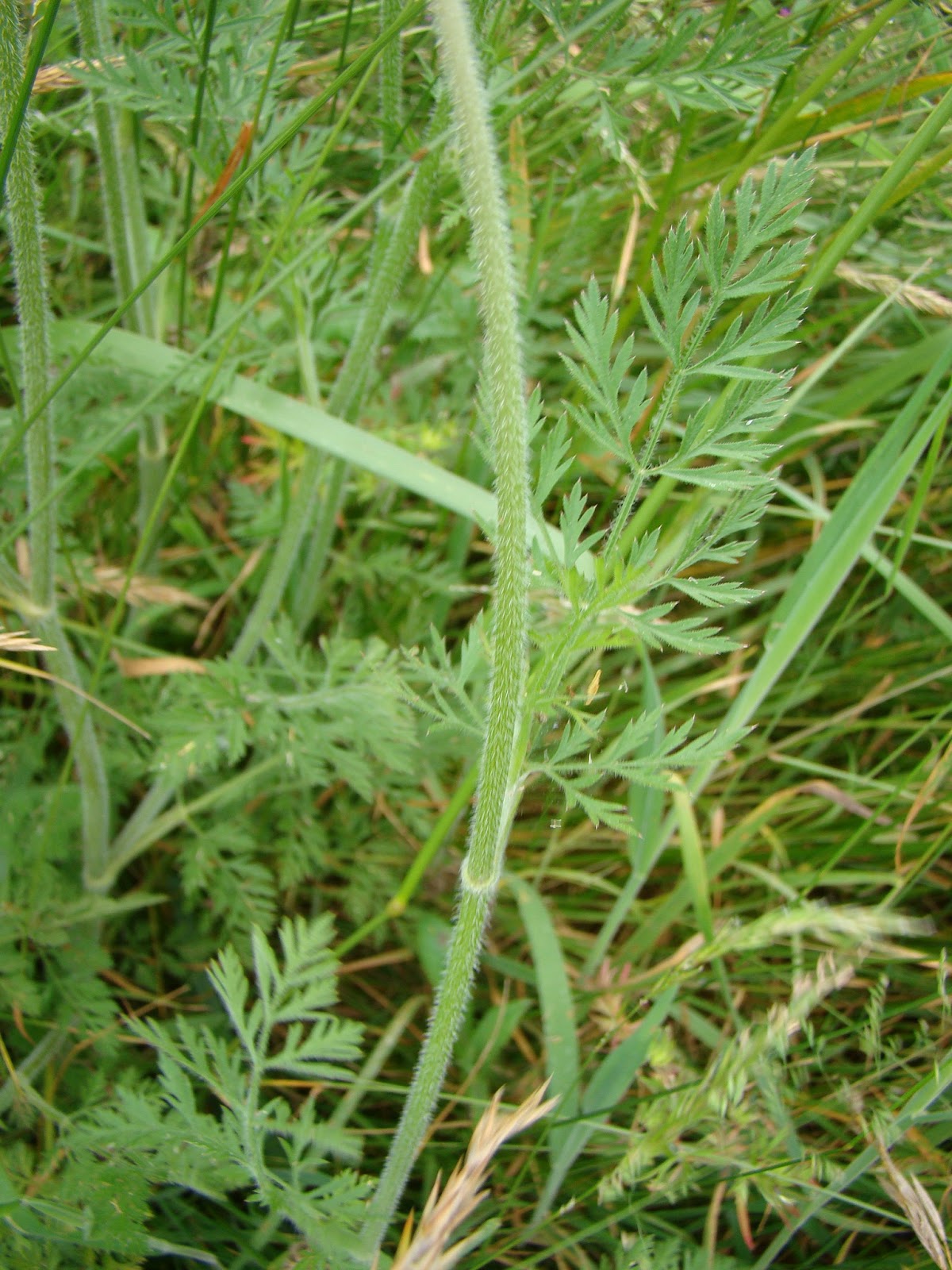
The leaf and stem of the wild carrot
Another identifying feature of wild carrot is one or several dark flowers in the middle of florescence but not every plant has them. At certain stage in plant's life this flower can be seen elevated over the rest of the bloom. This particular specie had several very dark purple flowers. I got a close up of the center.

Wild carrot dark flowers
If you pick wild carrot for medicinal or consumption purposed (young roots are reputed to be edible) be sure to identify it correctly as it does look very similar to other plants in carrot family, especially poison hemlock. To give you an example, right there in the marsh next to the wild carrot grows another plant, that belongs to the carrot family and looks strikingly similar.
Update. I have tried eating wild carrot roots and I say they are too woody to eat.
Wild carrot is biannual. Later in life the bloom folds in resembling a bird's nest.

Wild carrot bloom as a "bird's nest"

Water parsley bloom
The plant above is water parsley. It's edible and I have tried it. The stems of parsley are smooth and hollow.


