Showing posts with label Apiaceae. Show all posts

Sunday, May 27, 2012

Wild Carrot

 Wild carrot (Daucus carota)

Today I saw a wild carrot in the marsh. Strange because this plant prefers well drained soil. Perhaps that's why there were very few species around: it's just not their preferred habitat.

Update. Queen Anne rules in august. Wild carrot is everywhere. Poison hemlock is almost completely disappeared and was replaced by daucus carota.

Wild carrot plant, when seen in profile, has a "collar" right below the umbrella. "Queen Anne wears collar". Here is the picture:

Wild carrot in profile

When looking at wild carrot plant, notice that some of them have flat umbrellas and others have round ones. Here is an example with round umbrella:

 Wild carrot with round umbrella

Here is the picture of the wild carrot umbrella, view from the top.

Wild carrot flowers

Wild carrot is also known by its popular name Queen Anne's lace. It has solid stem. The stem is also hairy ("Queen Anne has hairy legs") or rather fuzzy. On the above picture you can also see some of the fern-like leaves. The plant is supposed to smell like carrot tops but I could not smell anything. When I tried some root, I could detect very faint carrot smell.

Here is the picture of the leaf and stem:
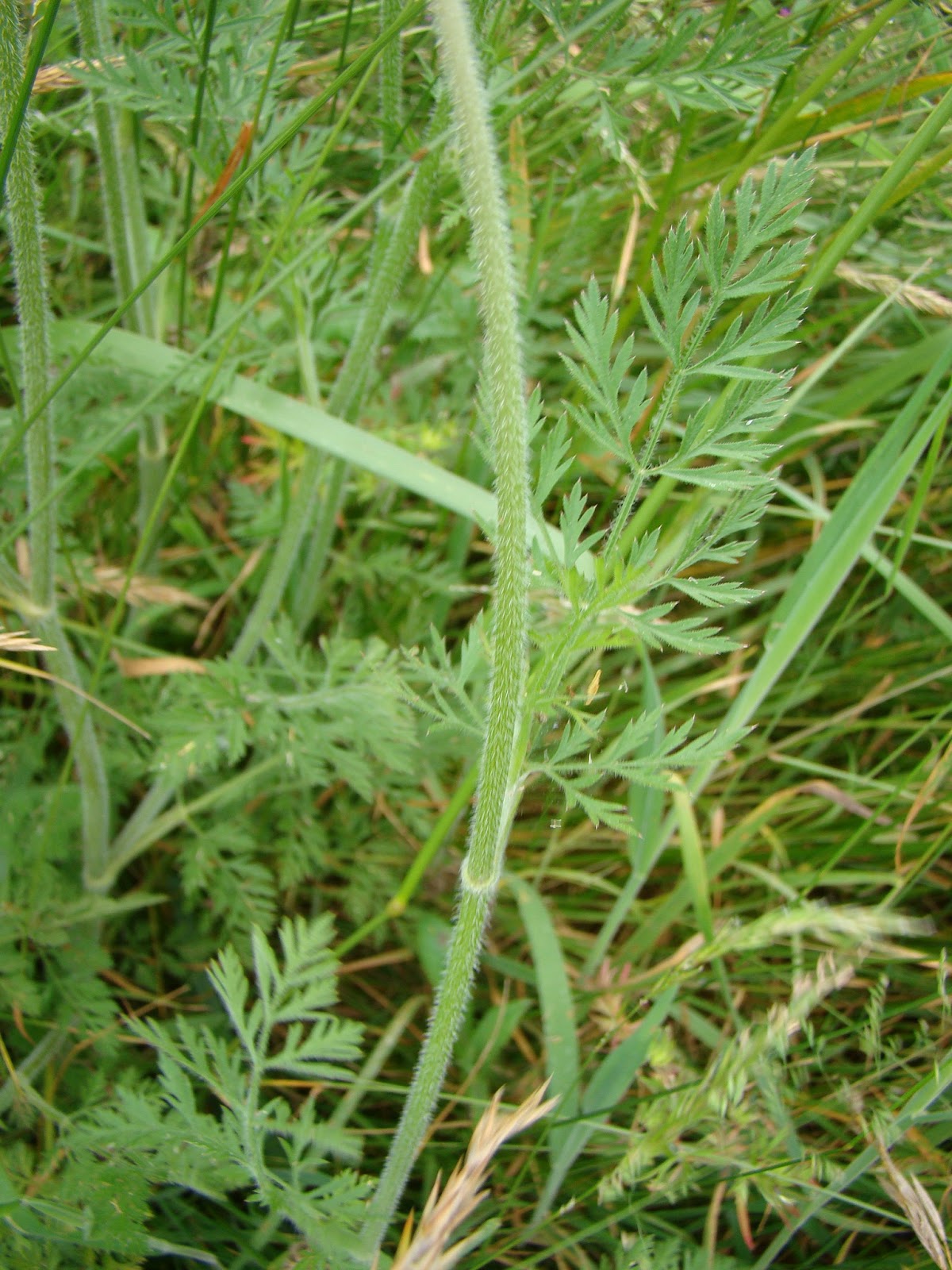
The leaf and stem of the wild carrot

Another identifying feature of wild carrot is one or several dark flowers in the middle of florescence but not every plant has them. At certain stage in plant's life this flower can be seen elevated over the rest of the bloom. This particular specie had several very dark purple flowers. I got a close up of the center.

Wild carrot dark flowers

If you pick wild carrot for medicinal or consumption purposed (young roots are reputed to be edible) be sure to identify it correctly as it does look very similar to other plants in carrot family, especially poison hemlock. To give you an example, right there in the marsh next to the wild carrot grows another plant, that belongs to the carrot family and looks strikingly similar.

Update. I have tried eating wild carrot roots and I say they are too woody to eat. 

Wild carrot is biannual. Later in life the bloom folds in resembling a bird's nest.

Wild carrot bloom as a "bird's nest"


Water parsley bloom

The plant above is water parsley. It's edible and I have tried it. The stems of parsley are smooth and hollow.

Saturday, May 5, 2012

Cow Parsnip

Cow parsnip is another plant of the Umbelliferae family featuring its signature umbrella shaped little flowers. Cow parsnip has huge leaves and can grow quite tall. The plant is very sturdy, has thick stems, somewhat hairy and hollow inside. Its Latin (botanical) name is Heracleum maximum, meaning "big" (like in Hercules).

Cow parsnip at Arcata marsh

Cow parsnip has really big leaves, easily recognizable.

Cow parsnip leaves

And here some good close-up of flowers

Cow parsnip umbrella, top view

And here a close-up umbrella in profile

Cow parsnip umbrella, side view

Interestingly, we found only one place where the cow parsnip grew and the patch was overgrown with all kinds of plants. But we saw it outside of marsh too, it's fairly common but not too common. Incidentally, I have read that cows don't like to eat it.

The juice of this plant contains phototoxin that reacts with the skin when exposed to ultraviolet rays. In other words, if you want to collect this plant, do it late in the evening (after sunset) or at night.

Thursday, May 3, 2012

Angelica

 Angelica in the marsh

I have heard of angelica plant for quite a while. I know it is valued for its medicinal properties and I even bought dong quai (Chinese Angelica) root capsules and I found them very good. I have never seen it growing wild though. That is, until a few days ago when I took a walk in remote marsh in Humboldt Wildlife Refuge.

Angelica 

Here it was, growing at the far end of the loop trail. There were a few patches but all on the far end of the loop. It's like the plant did not want to be found. I felt like a detective who finally found a person he's been hunting for.

Angelica plant in profile

Notice reddish stem. They are not reddish all over though, just some parts of the stem, sometimes you'll see reddish tint on one side of the stem. In the above picture notice purple blotches on the lower part of the stem: it is a signature feature of poison hemlock but hemlock has purple blotches all over the stem. Actually I noticed that lots of the marsh plants have some purple blotches on the stem so don't use that as a single identifying feature.

Angelica

This is a more typical example. The plant has reddish stem but usually on one side and a few small reddish speckles. The stems of angelica are smooth and hollow.

Angelica leaves

The leaves of angelica are wide and not at all like hemlock's lacy leaves.  Finally, the bloom is quite different too: angelica has umbrella shape flowers typical for parsley family that later develop into a bunch of rounded florets (or whatever the botanical term is). Here is the picture:

Angelica bloom

Another identifying feature of angelica is that the plant has a nice aroma. Hemlock is supposed to smell like a mouse. I guess that means dusty.

So here you have it: a dossier for angelica compiled by yours truly. I hope to see more of this plant in the future.

Sunday, April 29, 2012

Water Parsely

Let us leave redwoods for a little while and go walk in the marshes. Marshes usually have a very rich habitat with fertile soil so many plants really strive in this environment. One plant that is fairly common there is water parsley. Here is the picture of this plant growing among other plants:

Water parsley

In the above picture notice poison hemlock growing north of horsetail plants. Be careful to identify these plants correctly. Hemlock has lacy leaves, smooth stems and purple blotches on the stem. Parsley leaves are not so lacy.

Here is the picture of water parsley in bloom. Notice that parsley usually blooms when exposed to the sun. From my observations species in the shade seldom if ever have blooms.

 Water parsley bloom

Here is a nice branch of water parsley:

Water parsley composite leaf

Water parsley is reputed edible. I have tried it myself, it has kind of a mustard taste (that is mustard leaves, not the condiment). Again, be careful to identify it correctly though as parsley, hemlock, wild carrot and angelica have family resemblance (they all belong to Umbelliferae family, also known as Apiaceae or carrot family).

Here is another patch, mainly parsley than other plants:

 Water parsley at Butcher's Slough

Incidentally water parsley also grows in the redwood forest but it is more typical in the marshes. I happen to have a picture of parsley growing in the redwood forest:

More water parsley

Monday, November 28, 2011

Hemlock

 Hemlock in Kit Carson park, Escondido

Ah, the famous plant that was used to kill Socrates. Hemlock plant belongs to apiaceae (or umbelliferae) family. Also known as carrot or parsley family. Umbelliferae means "umbrella" because the majority of species form clusters of small flowers that look like little umbrella. The thing about this family is that lots of species do indeed have family resemblance and it mights be difficult to tell one specie from another. What adds to confusion is the fact that lots of them are edible while others are poisonous. Hemlock is the example of the latter.

Hemlock flowers

The plant that resembles hemlock the most is wild carrot (also known as Queen Ann's lace or Daucus carota). Unfortunately I don't have a picture of the latter for comparison. Actually I have not seen that many hemlocks around but there was one patch where it was flourishing together with other bunch of plants.

Hemlock leaves

Remember that hemlock is highly poisonous and even a little dose might kill you. Be very careful and make sure to identify any plant of the carrot family correctly as lots of them are very good medicinal plants, for instance angelica or spices like coriander.

There are actually two genera commonly known as hemlock: Conium that is discussed in this article and Cicuta (water hemlock). Both are highly poisonous, Cicuta is even more deadly than Conium.