Sunday, March 31, 2013

Violet

Violets are rather rare plants but I saw a few specimen in a redwood forest, namely in Jedediah Smith National Park and also some species in the march in Crescent City. It was not really the marsh but more like a grove of some kind of trees, not just redwoods. In fact, all my attempts to find a marsh that was supposed to be there according to the map failed. But I did find two new plants.

Violets are rather difficult to distinguish among different species as they all look alike save for the colour. Our particular violet is yellow, most probably Viola sempervirens.

Violet in Jedediah Smith National Forest

Violets are easy to identify by their irregular zygomorphic (vertical symmetry) flowers and round leaves (not all species). The flowers are quite small. They bloom in late March and early April.

Here is a picture of western dog violet (Viola adunca).

Viola adunca in Patrick's Point State Park

Monday, October 8, 2012

False Solomon's Seal

Solomon's seal at the Avenue of the Giants

False Solomon's seal (or star-flowered Solomon's seal) is a very attractive plant with silky smooth leaves. When in bloom, it produces small white flowers that turn into berries as the plant matures. Sometimes this plant covers a large ground forming a meadow right there in the forest. The plant likes semi shade and grows well under the trees.

False Solomon's seal flower turning into berries

The Latin name is Maianthemum stellatum, not to be confused with Maianthemum racemosum. The latter has much smaller flowers forming "plumes". I have not seen the latter plant in our forest wheres the former grows in abundance at the Avenue of the Giants. They are closely related though, as can be seen from the similar genus name. The plant known as Solomon's seal (the true) is a different genus: Polygonatum  (not to be confused with Polygonum, a totally different and unrelated plant) commutatum: a beautiful plant with lots of white bell shaped flowers. Unfortunately it does not grow in our part of the world but mainly in the eastern part of the country.

False Solomon's seal leaves

All the aforementioned plants belong to asparagus family (Asparagaceae).

The juice from Maianthemum stellatum is effective against nettle sting. Just rub the fresh leaf against the damaged part to release the juices. 

Sunday, October 7, 2012

Hebe

Hebe inflorescence. Notice the 2 long stamens and style. 

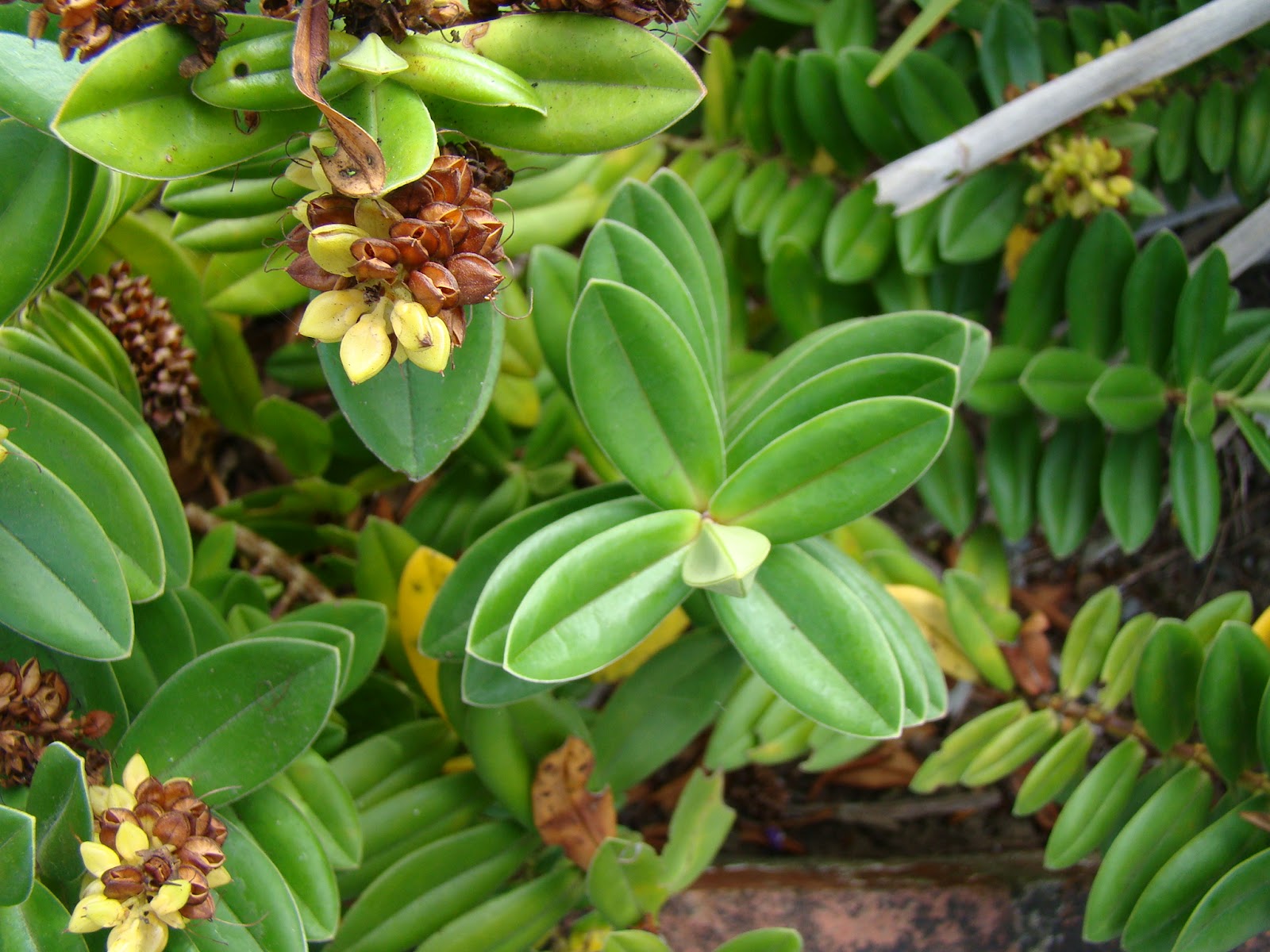
Hebe is a nice decorative plant that can be seen along the roadside as part of planted hedges. It has 4 almost perpendicular rows of leaves and flowered that are arranged in long spiked that come in different colors. The flowers have long stamens and style (middle parts inside the flower). When the flowers turn to seed, the plant loses much of its attraction as these seeds look like ordinary brown seeds that look more like grains of mud actually.

Hebe leaves arranged in cross-like shape along the stem.

Hebes are related to plantains and even more so to veronicas as they belong to the same family Plantaginaceae. This plant is the largest genus in New Zealand and apparently is much loved there. Hebes apparently don't take much care and therefore make a nice plants for hedges and flowerbeds as well as an excellent lawn plant.

Hebe view from the side. Notice how the leaves alternate along the stem.

Monday, October 1, 2012

Achlys

Achlys triphylla
 
Achlys, also known as vanilla leaf or deerfoot is a plant that can be found in the forest. So far I've only seen it twice, both times in a redwood forest. It is a rare plant and does not grow all over the place like, say, redwood sorrel.
Vanilla leaf (Achlys triphylla) is so called for its supposedly vanilla smell of the dried leaves. Well, I got one leaf, dried it and smelled it. It did not smell like vanilla! Why is it called vanilla leaf? Fresh leaves do not smell either. I am not going to call it that. I am going to call it achlys or deerfoot.

Deerfoot (Achlys triphylla)

Anyway, achlys is easy to recognize by the shape of its leaves: they are big, separated into 3 distinct parts that sometimes touch each other so it looks like one whole leaf. Achlys blooms too, but at the time when this picture was taken it was not blooming so I cannot show you the flowers.

Achlys belongs to the barberry family (Berberidaceae).  As a forest plant, it likes shade. Fresh leaves can be rubbed on skin to act as a mosquito repellent.

Saturday, September 29, 2012

California Poppy

 California poppy

California poppy (Eschscholzia californica) is the state flower of California. It has bright orange flowers and it is actually encountered in the wild a lot: you'll see it in meadows, as well as in lawns and flower beds.

California poppy

Poppy belongs to poppy family (Papaveraceae). Other members of the family include Matilija or tree poppy (Romneya) and opium poppy (Papaver somniferum). The latter is also the one that produces poppy seeds that we use in baking.

 Matilija poppy

Matilija poppy

Friday, September 28, 2012

Polygonum hydropiperoides

Polygonum hydropiperoides is another polygonum that can be seen at the marshes and swamps. The name means "looks like water pepper". Sometimes they can even grow partially submerged in water. This plant is much smaller than Polygonum cuspidatum discussed in previous post. It is just a regular plant with small white flowers.

In the picture below notice the distinct joint. This plant grew in water or at least very close to water as I could not get too close to it.

Polygonum hydropiperoides

And here is a view of close-up of the flowers. Notice the red stem.

Polygonum hydropiperoides flowers

Polygonum cuspidatum

Polygonum cuspidatum bush

Knotweeds, also known as polygonums (or polygoni?) belong to knotweed family (Polygonaceae), a characterristic feature of this family being that lots of plant have swollen  or at least dictinct joints. That is well reflected in the Latin name of the family: poly means "many" and goni means "knee" or "joint". As a typical representative of the family, polygonum is a classic example.

There are a whole lots of polygonum species. Some grow in or near the water and some on high ground. I found one specie growing on high ground right here in the town where I live. An interesting thing is that it seems to grow at just one particular location as I've never seen it anywhere else. It is probably Polygonum cuspidatum but the species are hard to tell apart.

And here is a close-up of the branch where you can see these swollen joints.

Polygonum cuspidatum joint

The stems are red or reddish. The leaves are big, nicely shaped and symmetrical.

Polygonum cuspidatum branch

The flowers are small, formed in spikes. In this particular species the flowers are white but some species have pink flowers. They are shaped the same though.

Polygonum cuspidatum branch

And here is a nice picture of close-up of the flowers Notice the black anthers.

Polygonum cuspidatum flowers

And while we are at it I have another picture of different polygonum species.