Showing posts with label Plantaginaceae. Show all posts

Sunday, October 7, 2012

Hebe

Hebe inflorescence. Notice the 2 long stamens and style. 

Hebe is a nice decorative plant that can be seen along the roadside as part of planted hedges. It has 4 almost perpendicular rows of leaves and flowered that are arranged in long spiked that come in different colors. The flowers have long stamens and style (middle parts inside the flower). When the flowers turn to seed, the plant loses much of its attraction as these seeds look like ordinary brown seeds that look more like grains of mud actually.
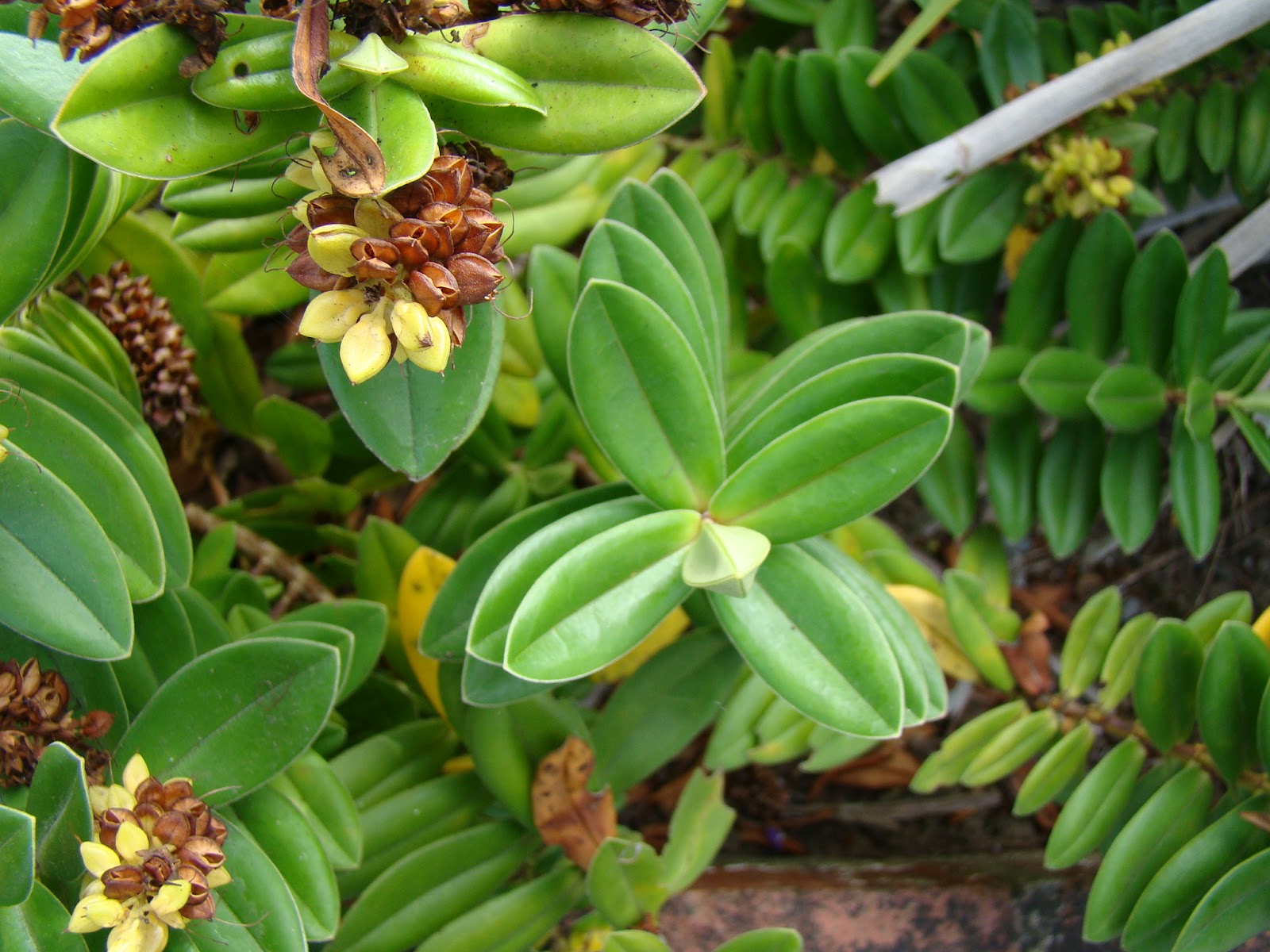
Hebe leaves arranged in cross-like shape along the stem.

Hebes are related to plantains and even more so to veronicas as they belong to the same family Plantaginaceae. This plant is the largest genus in New Zealand and apparently is much loved there. Hebes apparently don't take much care and therefore make a nice plants for hedges and flowerbeds as well as an excellent lawn plant.

Hebe view from the side. Notice how the leaves alternate along the stem.

Saturday, September 15, 2012

Plantain

 Plantago lanceolata (British plantain)

Plantain (Plantago) is a common plant that grows pretty much everywhere. It is as familiar as dandelion. Plantain usually catches everyone's attention. The most common varieties are broadleaf plantain (Plantago major) and narrowleaf plantain, also known as English plantain (Plantago lanceolata).

Plantain flower

The leaves grow in rosette and the stems are leafless bearing a compact narrow head of tiny flowers. I have read somewhere that plantain is supposed to be edible but I found it too fibrous and therefore don't recommend it.

Plantago lanceolata at the Arcata marsh

Plantain is a typical representative of the plantain family (Plantaginaceae) after which the family is named. Recently there has been some shuffling of the plants in and out of the families based on phylogenetic studies, the plantain family being especially affected.

Broadleaf plantain (Plantago major) at the Arcata Redwood forest

Indians used to call plantain "white man's foot" meaning that the plant spread with the white people's invasion into their land, reflecting in the language the introduced nature of the species.

Thursday, June 28, 2012

Linaria purpurea

 A herb garden at Humboldt fort

Today we took a walk in Humboldt old historical fort, a sort of museum where one can see artifacts from the lumber days of Humboldt county. There were also places where army barracks and officers quarters used to be (some still are). One of these places had a small garden attached to it. 

The thing about this garden is that it had more interesting plants than so-called botanical garden at the local community college. Just shows you that size does not matter.

There were many cool plants in this garden, many of them medicinal rather than culinary, which is understandable, considering it was attached to surgeon's quarters. Anyway, we'll have to begin with something. So we'll start with Linaria purpurea, commonly known as toadflax, perhaps the most showy plant in this garden.

Linaria purpurea with purple flowers

Linaria belongs to the plantain  family of plants (Plantaginaceae), a very diverse family, though formerly it was classified  as part of figwort family (Scrophulariaceae). Plants of this family make nice decorative plants in the gardens.

 Linaria flowers close-up

Linaria purpurea is a relative of snapdragon and you can see some family resemblance. The flowers can be purple, pink or white.

 Linarea purpurea plant

The leaves are narrow and oblong.  The stem is woody. The most common variety of toadflax is Linaria vulgaris, more commonly known as butter-and-eggs. The flowers look similar to Linaria purpurea but yellow in the middle surrounded by white top and bottom. I have never seen that plant in the wild yet.

Linaria means resembling Linum (flax). I don't see any connection, at least with a common flax. Here is the picture of the flax flower for you to compare:

Flax flower

They look like identical twins, don't they?

Tuesday, November 15, 2011

Veronica

 Veronica in Felicita Park, Escondido, CA

Veronica is a little wild plant growing in parks in meadows. I first noticed it in one of the city parks but I did not know what it was. It has four petals.