Showing posts with label Brassicaceae. Show all posts

Saturday, June 15, 2013

Searocket

Searocket. Notice the similarity to wild radish flowers.

Searocket (Cakile maritima) is another plant that can be seen among the dunes. It belongs to the Mustard family (Brassicaceae) as can be seen by its flower: notice the similarity to mustard and radish flowers. The flowers of searocket are small and pale mauve. As typical for other mustards, the mature plant produces pods.

Searocket (Cakile maritima) hiding among Ambrosia's leaves.

Note. The big leaves in two pictures actually belong to a different plant, Ambrosia chamissonis. But the leaves of searocket look very similar albeit much smaller. You can see some on the picture above. See my post about Ambrosia chamissonis.

Here is the picture of searocket leaves:

Searocket's leaves and flowers

Thursday, August 9, 2012

Iberis

Iberis at Humboldt fort garden

Iberis is a beautiful plant that would decorate any garden. It belongs to mustard family (Brassicaceae). The bloom consists of umbrella of several 4-petals flowers. The common name for these species is candytuft. According to Wikipedia, the name "candytuft" is not related to candy, but derives from Candia, the former name of Iraklion on the island of Crete.

Iberis is not supposed to be edible but has some medicinal propeties. It is chiefly cultivated as a decorative plant. 

Iberis flower close-up

Iberis species come in variety of colors. The most common are purple and white.

White iberis

Iberis in the garden

Wednesday, July 25, 2012

Arugula

 Arugula

Arugula (Eruca sativa) or rocket is an edible plant of the Mustard family (Brassicaceae). It looks amazingly similar to wild radish. I planted this one myself and a few plants actually grew. This was the second planting, as for the first one, none of the species survived.

Notice the characteristic 4 petals.

Arugula flowers

Sunday, July 8, 2012

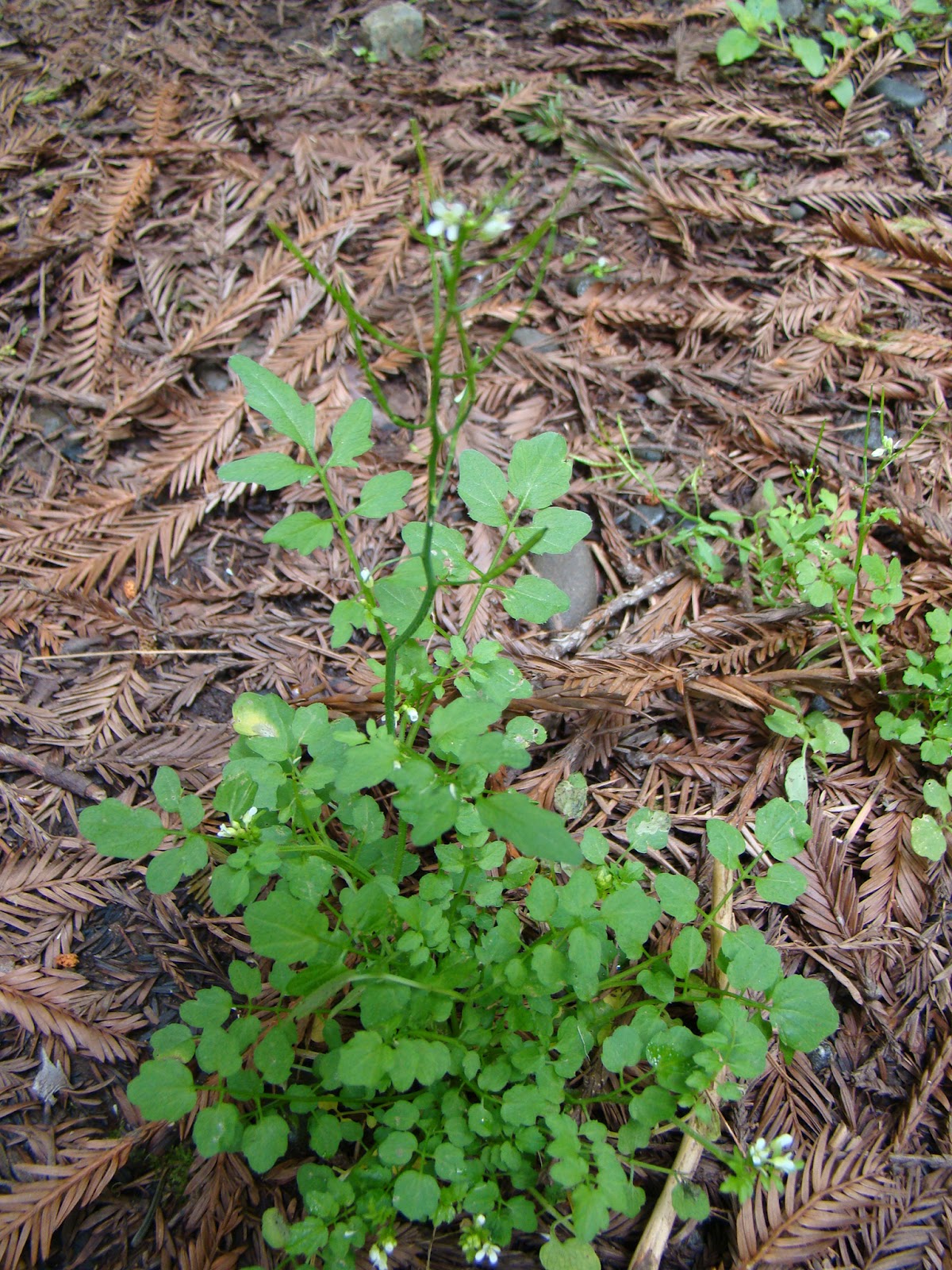
Bittercress

 Bittercress in a forest

Bittercress is a rare plant in the redwood forest. Part of the trouble is that it is extremely small, so unless you are looking for it, it's very easy to miss. Second, it is also inconspicuous. Some plants are small but quite showy. The plant actually perfectly blends with the surrounding vegetation and is hard to spot.

Bittercress (or just cress or cardamine)

The plant definitely belongs to mustard family: it has characteristic 4 petals miniscule flower and the leaves resemble that of watercress. It is most certainly some kind of a cress but I can't pin it down to the genus. I would say it is cardamine hirsuta (hairy bittercress) except it has no hair.

Wednesday, July 4, 2012

Milkmaids

Cardamine californica

Cardamine californica also known as milkmaids or toothwort is another plant that can be found in redwood forest, though unlike other plants that we discussed it is very rare (at least in our region). The flowers are white, fairly small but not tiny and have four petals. Four petals is a sign of mustard family though to me it surely did not look like mustard family because flowers are not small enough for mustard. So I checked the internet and whad'ya know! It does belong to mustard family (Brassicaceae). It seems to love shade.

Cardamine californica flowers

Another example of milkmaids

One thing I noticed about milkmaids is that they seem to be solitary plants, they don't grow in companies like redwood sorrel. I don't know if it is due to propagation methods or they just don't like company, the fact is that it is a rare plant in our redwood forest.

Tuesday, January 10, 2012

Wild radish


Wild radish (Raphanus raphanistrum) belongs to the mustard family and there is indeed strong family resemblance. Radish looks a lot like mustard, only the radish's flowers are purple and mustard's are yellow. There are also some species with white flowers, which are the cross between the two.

Wild radish leaves

Like mustard, radish grows everywhere. It is an edible plant: you can harvest young leaves and boil them twice and that will make a nice side dish for boiled or baked potatoes.

Like mustard, radish plant is found everywhere. It does not mind desert heat though it prefers moderate climate.

Tuesday, November 22, 2011

Sweet Alyssum

 Alyssum in Felicita Park, Escondido

alyssum is well... sweet. It is a plant of the mustard family with very small flowers that have a pleasant smell. Like most plants in the mustard family it is edible. You can add it to salads to add a little zest to your dish.

The flowers had 4 white petals and dark purple center. Here's a close-up

The Latin name for this plant is Lobularia maritima, formely known as Alyssum maritimum. However nowadays this genus is considered separate from Alyssum genus though the common name is still alyssum.