Wednesday, May 20, 2015

Elegant Clarkia


Recently we made a trip to Lake Nacimiento. Right now it is a dry season there which means the grass is all yellow and not many plants are growing right now. However we managed to find a few and I am going to post about them in this blog.

 The dry trail

 Lake Nacimiento view

One of the plants that I have not seen before was clarkia, particularly elegant clarkia. I saw another variety winecup clarkia in the Southern California. Clarkia (different varieties) is a hardy plant and does not seem to mind desert conditions. The flowers are usually purple.

Elegant clarkia (Clarkia unguiculata) have distinctly  separated petals. It is one of the rare plants that are fairy common in oak forest.

Elegant Clarkia at Lake Nacimiento

Elegant Clarkia flowers

Here is a winecup clarkia (Clarkia purpurea) for comparison.

Clarkia purpurea at Lake Nacimiento

Notice that all clarkias have 4 petals.That is usually the sign of the Evening primrose family (Onagraceae)  and indeed clarkia is a member.
 

Monday, June 23, 2014

California Horkelia


Horkelia californica

California Horkelia (Horkelia californica) is a rare plant that I found in our oak grove. There are just a few patches along the dry bed of a brook. The only other flowering plants there right now is milkweed (Asclepias). So what can we deduce by looking at the plant?

Horkelia flower

Well, it is covered by by fuzz much like the plants of the borage family. Is it a member of Boraginaceae? No. The flower is rather small with five white petals? Could it be a member of Caryophyllaceae (Carnation family)? No. The plant belong to... Rose family. Yes, it does not resemble any known Rosaceae members except for the fact that it has 5 petals.

A flower before (or after) petals become white

Thursday, May 1, 2014

Proboscidea parviflora


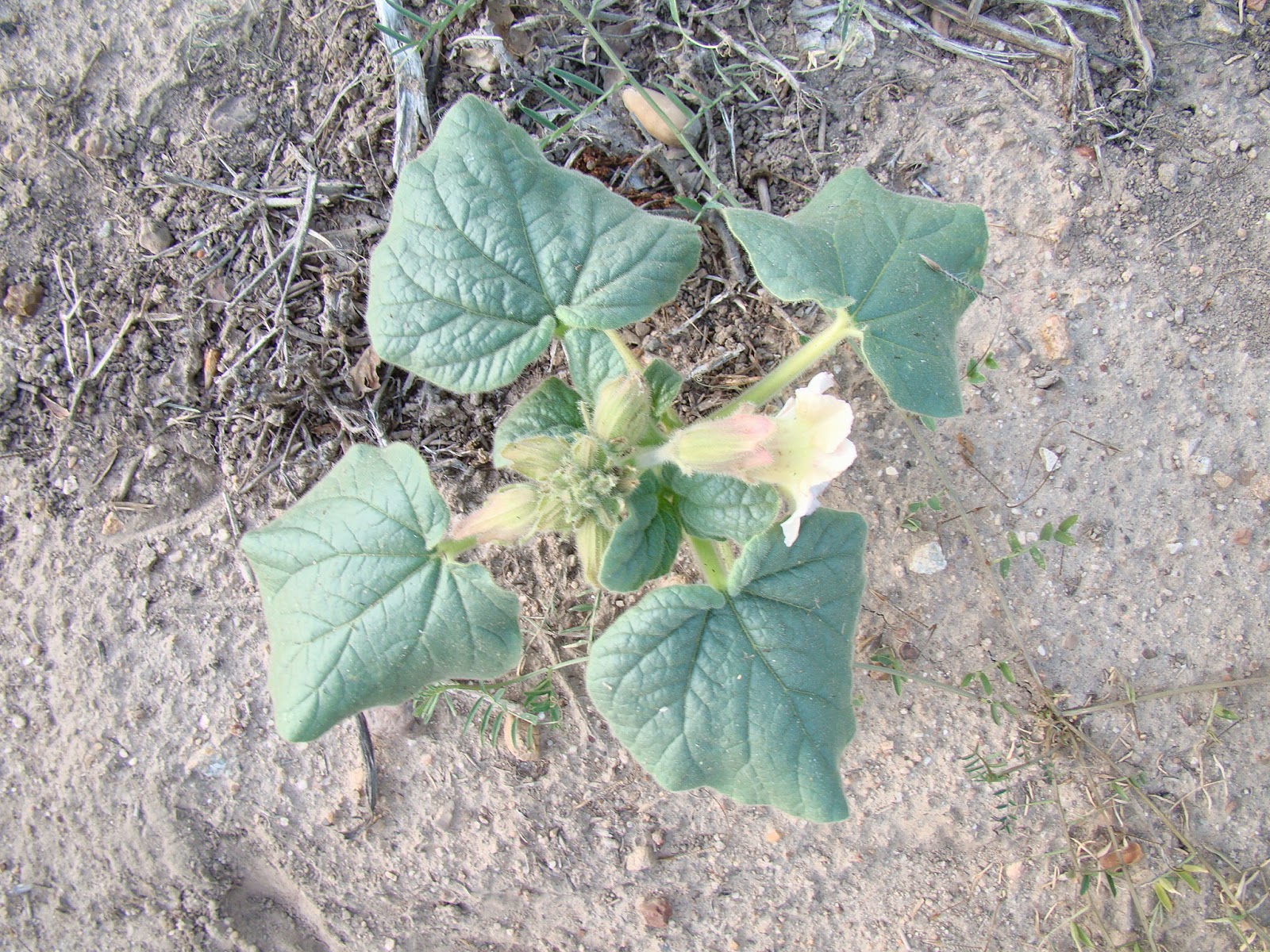
Proboscidea parviflora definitely looks like a desert plant

Today I am going to show you one of the very rare plants. Well. at least it is rare in this area. The name is Proboscidea parviflora or devils horn. Other common names are ram's horns, devils' claw or unicorn plant. It is a low growing plant with big wide leaves. The flowers are rather big compared to the size of the plant. The plant produces seed pods that look like ram's horns. hence the common name. The stem is covered with hairs and is sticky to the touch.

Proboscidea parviflora

In spite of the sinister name, the fruits of this plant are edible while they are soft. As they mature they become too woody.
 
Proboscidea parviflora (devils' horns)

The plant is part of the family Martyniaceae. It used to be part of the order Scrophulariales (the order is the rank above family, indeed it does have superficial resemblance to Schrophulariae) but now is considered to be part of Lamiales.

Wednesday, April 30, 2014

Brodiaea


 Brodiaea californica

There are two kinds of Brodiaea that grow near the place where I live. It used to be part of lily family, in fact the common name for it is cluster lily. Now it is considered to be part of the Asparagus family (Asparagaceae). The plant grows from corm (kind of like tuber , basically a storage organ that allows plant to survive cold winter or hot summers). The six petals are joined at the base to form a tube. There are a few leaves but they don't join the stem but grow from the corm. The stem is bare.

Blue dicks in the meadow

So one genus is more commonly known as blue dicks: these are the ones that carry cluster of blue flowers on one rather tall stem. The Latin name is either Dichelostemma capitatum or Brodiaea. (There a few more synonyms. I prefer the term Brodiaea as the flower is exactly identical to the one that is known as Brodiaea californica. Those are very low growing plants similar to blue dicks but they carry only one flower per stem and the flower is a little bigger.

And here is Brodiaea californica. The two kinds of flowers are commonly seen together if you catch them at the right blooming period which is rather short.

Brodiaea californica

On the side note there is yet another plant that is most likely belong to the Asparagus family because it looks a lot like a wild asparagus but I am not really sure as it is almost impossible to find good pictures of wild asparagus. (But there are more than plenty of the cultivated kind.) So for the curious here is the picture. If you can identify it, please leave a comment below.

Unknown plant (Wild asparagus?)

Close-up of the stem looks like wild asparagus

Mallow


Mallow (Malva parviflora) looks good in any meadow

Mallow is a nice plant that grows in abundance in Southern California. It also grows in some places along the trail in the oak forest where I quite often go for a walk. Mallow (Malva parviflora) first attracts your attention with rather big geometrical leaves. In the time of bloom one can notice little whiteflowers hiding under the leaves . The blooming season is short and soon these flowers turn into interesting looking fruits.

Mallow is also considered a medicinal plant as the leaves extract has anti-inflammatory and antibiotic properties. I don't know about chewing a mallow leaf but I would try to rub the leaves against some minor wounds or burns.

Malva parviflora flower

And here is the fruit. It's not unusual to see flowers and fruits on the same plant.

Mallow seeds

Mallow is the core representative of its family, Malvaceae. You might be interested to know that some other well-known members of this family include such commercial crops like okra, cotton and cacao. Hibiscus is another well-known member of this family.


Tuesday, April 8, 2014

California Buttercup


Ranunculus californicus flower

California Buttercup or Ranunculus californicus is a common species of buttercup though it seems that common buttercup (Ranunculus crepens) is much more...well... common. Up till now I have only seen the latter. The difference is in the number of petals: the creeping variety has only five while californicus has lots of petals (around twelve, though the number varies among species). The leaves are similar: deeply lobed dark green. In fact even in this area this plant is not widespread, unlike creeping buttercup, california variety is rather sparse.

Below you can see the different species of ranunculus.  As the name implies, both are part of the family Ranunculaceae.

California buttercup in the oak grove

And here is the picture of creeping buttercup for comparison:

Creeping buttercup is at home in all kinds  of habitat

Want to see the cultivated variety? Ranunculus makes a vary nice decorative flower as well. Of course you can hardly recognize it, like a rose cultivar, it looks quite different from its wild brothers. In fact, to me it looks very much like a rose.

 Yellow ranunculus cultivar

Friday, March 28, 2014

Menzies' Fiddleneck


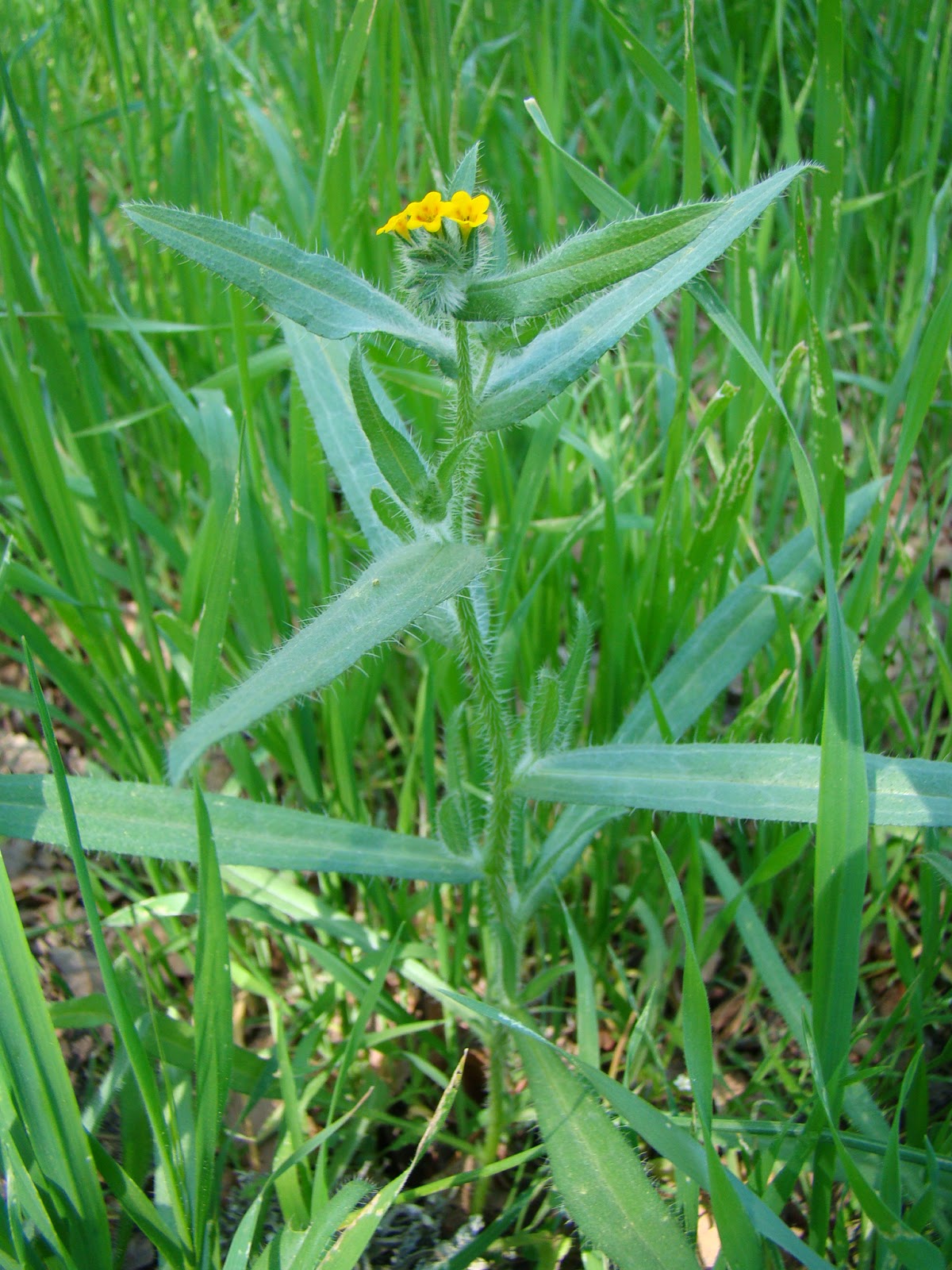
 Menzies' fiddleneck

Amsinckia menziesii is a plant of Borage (Boraginaceae) family that right now is blooming in the oak grove where I sometimes go for a walk. They are all over the meadows. Fiddlenecks have small but bright yellow flowers with reddish spots on each petal.

Close up of the fiddleneck flowers

When the plant matures, the upper part of the stem curves, hence the name fiddleneck. The plant starts as a rosette but then grows into erect stem with alternate leaves. Both stem and leaves are covered with coarse hairs, which is typical for borage family.

Fiddleneck inflorescence

Fiddlenecks were one of the first flowers to appear in the meadows and it still doing well. The genus Amsinckia have several species but they are hard to tell apart. Some native Americans used this plant for medicinal purposes.

Monday, December 23, 2013

Calypso Orchid


Calypso bulbosa in the forest

Calypso orchid (Calypso bulbosa) is the rare plant. As the name implies it is the member of the orchid family that is not common in Northern hemisphere but quite abundant in tropics. Strangely enough orchids  are about as numerous as Asteraceae and which family holds more species is still unclear. To give you an  example, vanilla plant is an orchid. Yes, the same plant that they harvest to produce vanilla extract. Orchids are also famous as 'hobby" plants as lots of them require meticulous care. Lots of Orchidaceae have flowers of unusual shape, colour or fragrance that make them popular decorative plants.

Calypso (Venus's slipper) close-up

But not our little calypso. This particular genus (Calypso which means concealed) grows in the northern forest. The several species I found were blooming wild in Crescent City, the northernmost town of California (that is not counting Smith River). It grows in other northern counties as well. The plant is rather small and grows in the shade so it is indeed easy to miss and the species are solitary. The name bulbosa refers to the bulbous corms (swollen parts of underground stem) whose function is to store stuff to survive winters.

Calypso flower in profile

Calypso is also known as Venus' slipper or fairy slipper because of its shoe-like shape of the flower. The coloring is pink spots and stripes on white background.

One interesting fact about Calypso is that it sometimes attracts bees by its yellow anther-like hairs but they produce no nectar so bees feel deceived and avoid visiting the plant again.

Thursday, November 28, 2013

Red Valerian

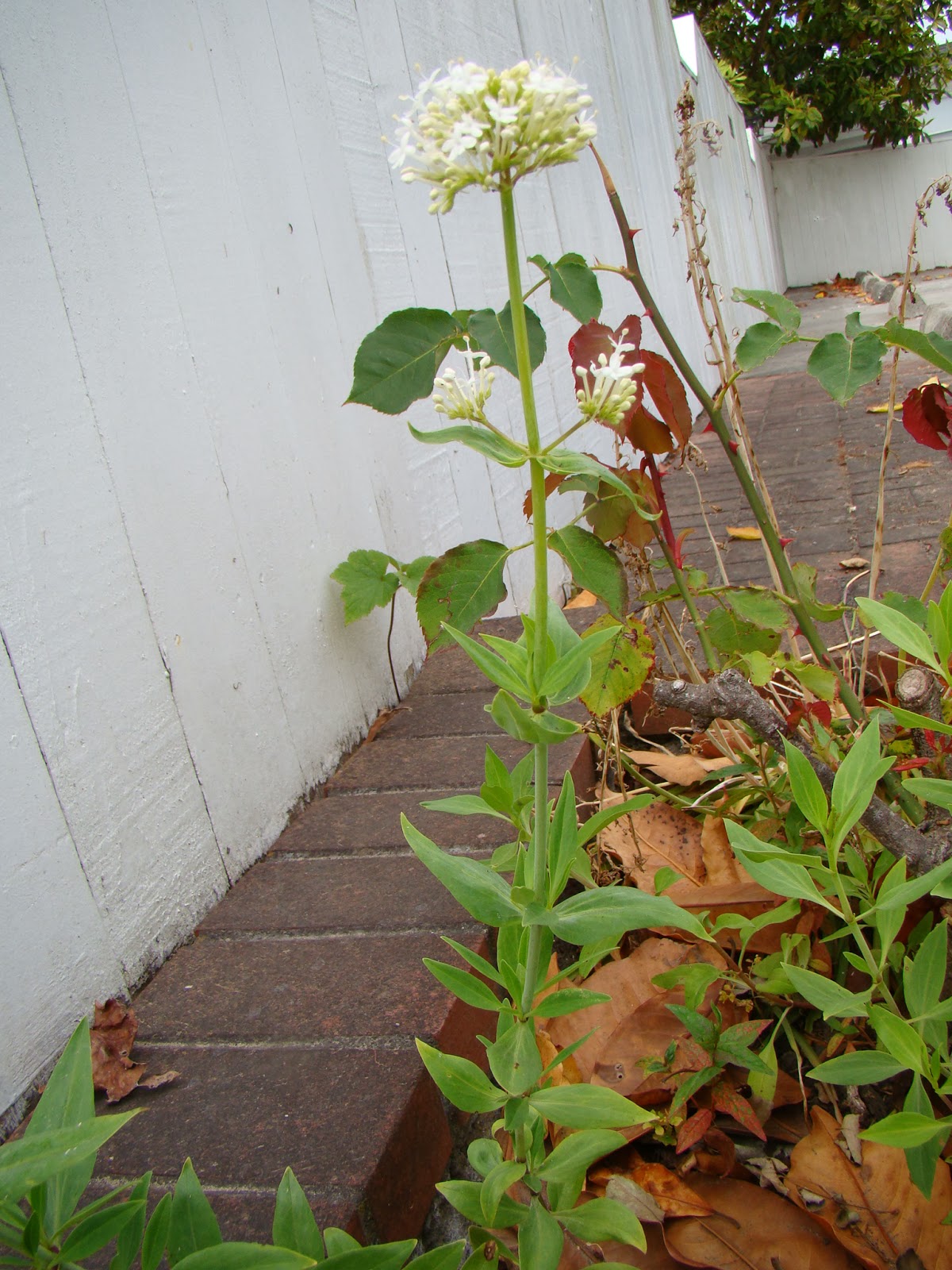
Red valerian is not exactly a wild plant, but it seems to grow without any care on the curbs where it was planted for decoration. It is a garden escape and can grow wild. It is a very attractive plant. It is not closely related (i.e not the same genus) to the garden valerian (Valeriana officinalis) though it does belong to the same family Valerianaceae.

Red and white varieties of red valerian growing at the curb

The Latin name for our friend red valerian is Centranthus ruber. You can see plants with red or white flowers. Oddly enough, even species with white flowers are still considered Centranthus ruber (ruber means red, in case you didn't know).

Close-up of flowers of red valerian

The flowers are fairly small and grows in (typically) round clusters. The flowers have peculiar shape which makes plant easy to identify. The leaves are opposite. Presumably the plant is edible (leaves and roots) but I haven'r tried it yet. Unlike true valerian, this plant is not considered to be medicinal.

White form of red valerian

Centranthus ruber makes an excellent garden plant. It attracts pollinators like bees and butterflies, takes minimum care and is attractive to look at.

Thursday, November 7, 2013

Pacific Ninebark


 Pacific ninebark behind twinberry

Pacific ninebark (Physocarpus capitatus) is not a herb but a shrub. The common name gets its name from the fact that the bark is peeling away in layers but I haven't really looked at the bark because I did not know what the plant was at the moment. Notice on the above pictures that the plant in the front is twinberry.

Pacific ninebark flowers and leaves

It's a shrub that puts forward round clusters of white attractive flowers. The plant belong to the Rose family (Rosaceae) so expect to see 5 petaled flowers with lots of stamens. The flowers and the leaves do indeed remind those of Rubus (thimbleberry, etc) except they are small and form round clusters.

This plant likes wet habitat so it can be most often found along the rivers. However it is drought-tolerant and therefore became a popular garden plant. Personally I have not seen this plant often.

Saturday, September 14, 2013

Greenspot Nightshade


Solanum douglassii

Greenspot Nightshade (Solanum douglasii) is a plant that I found growing on the Pacific coast of central California. It seemed to like to wind itself around other bushes. Anyway there are lots of species of Solanum but the fine specimen in question is Solanum douglassii, Douglas' nightshade. 

Solanum douglassii stem. Notice white hair

Let's check the characteristics: the stem is covered with white hairs. Check. The leaves have smooth or toothed edges. My species has toothed and wavy edges. The inflorescence is an umbel-shaped array of small flowers. Check. Green spots at the bases of corolla. It took me a while to notice them but they are there. As a bonus, some plants had nice black berries growing. Native Americans used the berries medicinally though I don't know exactly what for. 

 Solanum douglassii flowers. Notice green spots on the petals

Some species of Solanum, like Solanum nigrum (black nightshade) are rumoured to be edible but you have to try it at your own risk. Also if you cook the leaves of the aforementioned black nightshade, like boil them 2 times for 15 minutes, it also supposed to make them edible but again, do it at your own risk as there is no guarantee that they are edible and toxicity within the species may vary greatly. Note that only ripe berries are edible. You have to be absolutely sure it's Solanum nigrum as some species look very similar to it but they are toxic. 
 
 Solanum douglassii flowers and black berries

Notice that the pictures in this post are of Solanum douglassii. I did not find information on its edibility.

Thursday, September 12, 2013

Yellow Star Thistle


 Yellow Star Thistle

Yellow Star Thistle (Centaurea solstitialis) is a member of the Aster family (Asteraceae) that can be frequently seen in empty dry lots and commons. The plant is also known as golden star thistle and St. Barnaby's thistle. As usual, the common name thistle share several Latin names, for example a well known plant bull thistle is a different genus, Cirsium vulgare.

Centaurea solstitialis flowers with thorns

Yellow star thistle is a good name though because the thistle does indeed look like a star, but that effect is produced not by flowers but by long thorns sticking around it.

Wednesday, September 11, 2013

Vinegar Weed


 Trichostema lanceolatum (camphor weed) at Lake Santa Margarita

Vinegar weed is a very interesting plant. It has small elongated leaves and relatively big flowers with long parts sticking out. It was obviously a plant of the mint family. I was lucky to identify it very soon after I took a picture: the plant in question is called Trichostema lanceolatum, part of the Mint family (Lamiaceae). Like other mints it has square stem. The common name is not quite right. The plant indeed has a very strong smell, it feels juicy to the touch but I would not describe it exactly like vinegar smell. The smell is quite pleasant though pungent. That pungent smell is referred to in common names like turpentine weed and camphor weed. Camphor smell would probably be the closest description. As far as I know it is not edible.

Trichostema lanceolatum grows in dry hard soil in hot climate

The plant is striving in hot climate in dry soil though so far I have only seen it in one place: Lake Santa Margarita where the photographs have been taken. I read that the smell is produced by volatile oils and these oils also help to keep other plants away.

Notice the similarity to another plant called wooly blue curls. The Latin name for that one is Trichostema lanatum. Notice the same genus, Trichostema.The latter plant is extremely rare.

Monday, August 26, 2013

Ambrosia artemisiifolia


Ambrosia artemisiifolia

Ambrosia artemisiifolia or comon ragweed is the most widespread species of Ambrosia. I have already written about silver burr ragweed (Ambrosia chamissonis). Indeed you can see close resemblance between two different species of the same genus Ambrosia. The leaves look very similar and the tassels of flowers are common to both. But Ambrosia chamissonis grows mainly on the sea coast while Ambrosia artemisiifolia is common on the dry land. It does not mind the hot climate. Beach variety is also more prostrate while common ragweed plants grow tall.

Common ragweed flowers

The name artemisiifolia is given to the plant because the leaves resemble those of a related genus Artemisia (wormwood or sagebrush). The smell is also somewhat similar though Ambrosia have tougher leaves and bigger flowers (still very small though) that are green or yellow. An interesting thing about common ragweed is that it is supposed to be one of the major culprits of hay fever though I personally never suffered from this particular plant.

Like Artemisia, Ambrosia belongs to the Aster family (Asteraceae).

Sunday, August 25, 2013

Conyza canadensis

Conyza canadensis

Conyza canadensis or horseweed is a plant that can be found in dry (and not only) areas. With Croton setiger and Ambrosia artemisiifolia it makes the big three that can be found blooming in the heat of the August on the dry plains. So what can be found about conyza?

Conyza canadensis

Other names for conyza include coltstail, marestail and butterweed. The former two are obvious for the plants's resemblance to coltstail. Note that there are plants named horsetail (Equisetum) and mare's tail (Hippuris) that are quite different from Conyza. The name butterweed is most likely given for the plants resemblance to senecio genus, which is commonly known as butterweed (among other common names).

Conyza flowers. Notice resemblance to senecio.

One interesting fact about conyza is that the plant developed resistance to herbicides. Another fact is that Zunu Indians used crushed flowers to cause sneezing by inserting plants in the nostrils.

As the name canadensis implies, conyza grows in Canada and also in Britain so it is not exclusive to hot climate though it sure strives here. During the heat the top of the plant can be seen wilting down but it straightens up when the air becomes cool.

As you can guess by looking at the flowers conyza is part of the aster family (Asteraceae).

Wednesday, August 21, 2013

Croton setiger

Croton setiger, commonly referred to as turkey mullein is a heat tolerant plant that is quite common in the dry area. Well, at least it's common at the area where I live right now. The plant is amazing: 100 degrees heat and full sun and it's looking nice and green. However even this hardy plant can have too much: recently I saw few species dried to a crisp from long exposure.

Croton setiger in a desert area

So the name mullein points to similarity to common mullein. Indeed, both plants have fuzzy leaves. But that's all they have in common. These two plants are not related. Common mullein's Latin name is Verbascum thapsus and it belongs to Figwort family (Scrophulariaceae). Croton is part of the Spurge family (Euphorbiaceae). The flowers are quite different too: verbascum has distinctive yellow flowers with 5 petals. Crotons's flowers are tiny and formed into clusters of sandy color.

Croton setiger close-up

Croton' leaves have pleasant smell when crushed, provided the plant is healthy. The leaves are fuzzy. here is the close-up of flowers:

Croton's flowers