Thursday, June 13, 2013

Yellow Sand Verbena


Abronia latifolia on the beach

Let us leave the garden and take a walk on a beach. Dune habitat has its own plant life and although it might not be as exuberant and exciting as the forest or meadow, nevertheless there are some unique species there that are not found anywhere else. Usually these plant have "dune" or "beach" or "sand" as part of their common name. Sometimes it is a species peculiar to beach habitat wherefore other species of the same genus strive in different environment. An example of such a plant would be morning glory. It grows pretty much everywhere where thee is enough sunshine and moisture. The genus species in Latin is called Calystegia. There are quite a few. The most common species is Calystegia sepium. The beach morning glory species is Calystegia soldanella.

With verbena things are getting hairy. First of all, the common name verbena has nothing to do with the genus named Verbena (it's the Latin name too) which is part of the Verbenaceae family. Sand verbena in Latin is called Abronia and the yellow variety that we are interested in is called Abronia latifolia. (Latifolia means "with broad leaves".) Our friend arbonia belongs to Four O'Clock Family (Nyctaginaceae)

The flowers of Abronia latifolia are arranged in neat round heads. The leaves are succulent but rough to the touch. It can be seen on the beaches and dune habitat but the plant is not very common.

Nigella


Nigella

Nigella is an interesting garden plant that has a very distinctive appearance. The leaves are dill-like. The flowers are rather big, blue with a big protruding middle part with tentacle-like filaments (stamens?). I see it occasionally on the curbsides.

The seeds in some varieties are edible and known as black cumin or onion seeds (yeah, I know). Though the name cumin can refers to a couple of other plants. Nigella seeds are widely used in Indian cuisine.

Nigella is easy to grow in the garden. The plant is self seeding.

Nigella is part of the buttercup family (Ranunculaceae).

Nigella seed capsule

Nigella has dill-like leaves

Sunday, June 9, 2013

Blue Star Creeper

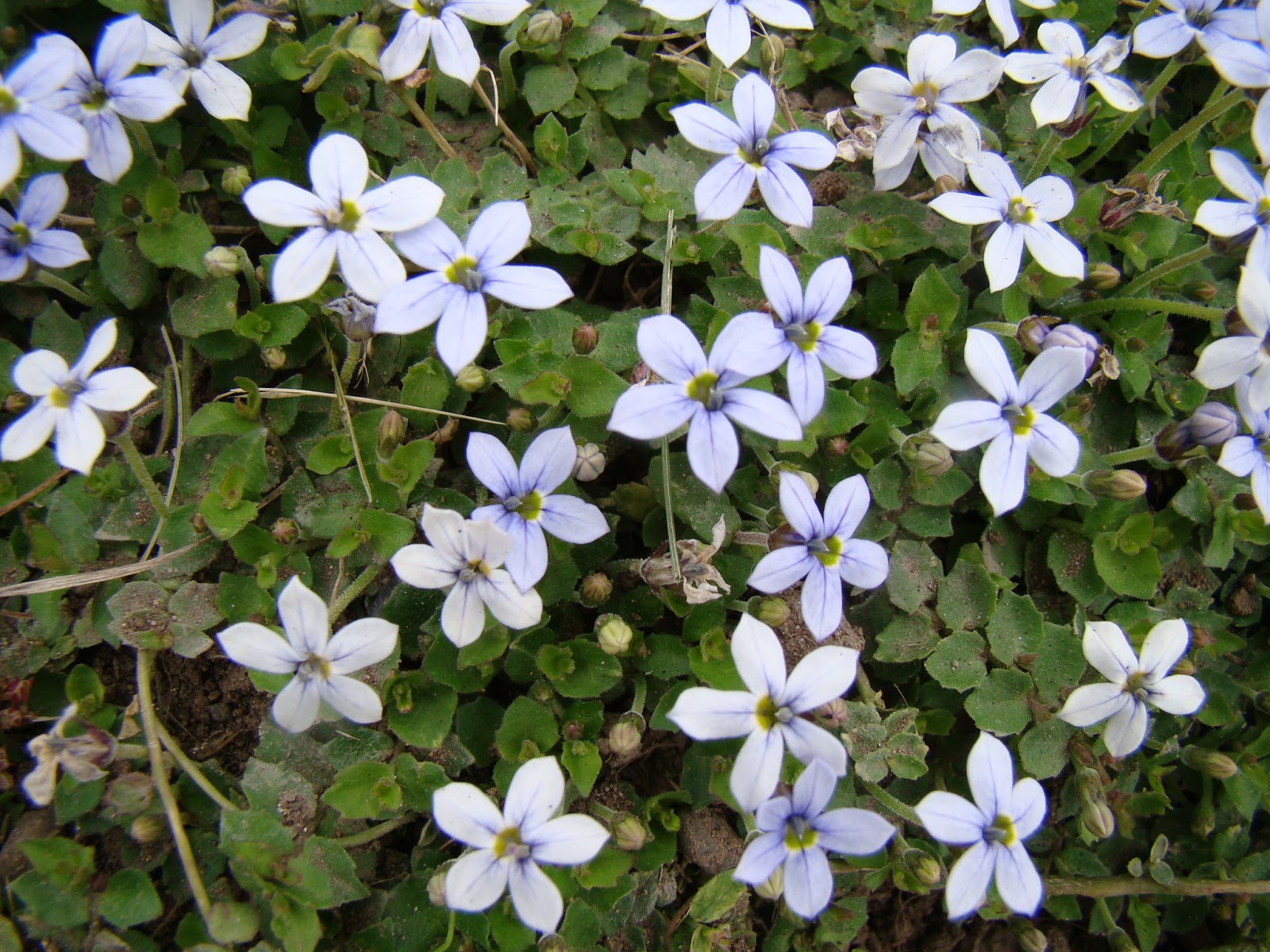
I don't know how "wild" Blue Star Creeper plant is but so far I only saw it at the curbs and on some neglected looking lawns. I did some research about it and found out it's actually quite valuable garden/lawn plant, especially valued for its tolerance to be walked upon (like camomile) and therefore can be planted in cracks between stone slabs, tiles, pathways or wherever else you want to have flowers rather then dirt. The plant is very low growing (a creeper), the pale blue flowers are small but bright and cheerful and they certainly catch the eye.

Here is the picture of that curb:

Blue Star Creeper

And a little more close (notice the yellow spot in the middle):

Blue Star Creeper

And here is the picture of the single plant in a profile. It is rather small, about the length of a finger though on the ground it seems much shorter:

Blue Star Creeper

 Blue Star Creeper's Latin name is Isotoma fluviatilis. It belong to the family Campanulaceae. I don't know why, it certainly does not look like a bell flower to me but we leave the nomenclature to the botanists.

This flower can bloom for a long time until the frost gets it so it's perfect for permanent warm climate. Here it does not bloom in winters.

Monday, June 3, 2013

Gilia millefoliata

Gilia is a very small and inconspicuous plant that grows in meadows. There are several species in the genus, the one we'll look at today is called Gilia millefoliata, which translates literally as "thousand leaves" gilia. It grows in sand dunes habitat along the coastlines. The flowers are usually blue but very small though the stem can reach 5 or more inches. The stems are fuzzy. The leaves are similar to yarrow leaves. In fact common yarrow is known as Achillea millefolium.

Gilia is part of the phlox family (Polemoniaceae), together with such genera as polemonium (Jacob's ladder) and phlox. Do not confuse phlox with flax, which belongs to a different family (Linaceae).

Some time ago we went to plant exhibit and there were among others various species of phlox family. Well, one can hardly tell them apart. Just looking through my archives, there were such species as linanthus, collomia, phlox, the only difference being that some flowers were pink and some were white. I was not able to find any of them in the wild to give you pictures.

But we do have some good pictures of gilia. So here goes:


 Gilia millefoliata

The view of the flower from above:

 Gilia millefoliata

And just for fun along the same trail I happened to notice some yarrow so you can see the similarity in leaves. Millefoliata in gilia obviously does not apply to petals as there are only five of them therefore it must refer to pinnate (feather-like) leaves.

 Achillea millefolium

Sunday, June 2, 2013

Johnny Tuck

Johnny tuck (Triphysaria eriantha) is a beautiful plant that grows rather low but attracts attention by its colourful flowers that are arranged around stem-like formation. The plant is part of the Broomrape family (Orobanchaceae) and you can see similarities in flower shapes with such notable members of the same family as owl's clover and yellow parentucellia (yellow bartsia).

Many member of Orobanchaceae are  root parasites meaning they attach themselves to the roots of other plant to obtain sustenance for themselves. Many plants are partial parasites meaning they can complete their life cycle independently from the host plant.

Here is a picture of johnny tuck.

Johnny tuck at the beach trail 

And here is a close-up

Johnny tuck

Note that sometimes this plant is refereed to as butter-and-eggs though this appellation is more commonly applied to another plant, Linaria vulgaris, also known as yellow or common toadflax.

Friday, April 5, 2013

Cream cups

This plant with a name that conjure confectionery delights in your mind is actually a very small flowers growing in meadows. This particular specimen grew on a hilly meadow right next to the ocean. Most species were yellow but a few were white. The plant does not seem to be common.

  Cream cups in a grassy meadow near Crescent City

So what else can we find out about this plant? Its Latin name is Platystemon californicus and it is the only species within the genus Platystemon.  The plant belongs to the Poppy family (Papaveraceae). The flower has 6 petals with yellow spots.

Cream cups flower

Cream cups are low growing plants but the bright flowers attract attention. There were several other plants growing in that same meadow but more about them is coming in future blog posts.

White Platystemon californicus

Notice that that petals are sometimes angular and sometimes rounded. The spots are present in the majority of species but not all of them  (like the yellow flower in the above photograph does not have them or they are hidden by the center parts.). 

Sunday, March 31, 2013

Violet

Violets are rather rare plants but I saw a few specimen in a redwood forest, namely in Jedediah Smith National Park and also some species in the march in Crescent City. It was not really the marsh but more like a grove of some kind of trees, not just redwoods. In fact, all my attempts to find a marsh that was supposed to be there according to the map failed. But I did find two new plants.

Violets are rather difficult to distinguish among different species as they all look alike save for the colour. Our particular violet is yellow, most probably Viola sempervirens.

Violet in Jedediah Smith National Forest

Violets are easy to identify by their irregular zygomorphic (vertical symmetry) flowers and round leaves (not all species). The flowers are quite small. They bloom in late March and early April.

Here is a picture of western dog violet (Viola adunca).

Viola adunca in Patrick's Point State Park