Wednesday, July 25, 2012

Arugula

 Arugula

Arugula (Eruca sativa) or rocket is an edible plant of the Mustard family (Brassicaceae). It looks amazingly similar to wild radish. I planted this one myself and a few plants actually grew. This was the second planting, as for the first one, none of the species survived.

Notice the characteristic 4 petals.

Arugula flowers

Sunday, July 22, 2012

Red Salvia

 Salvia splendens or tropical sage

Red salvia (Salvia splendens) does not look like a common sage at the first glance. Yet, look closer and you will see that it has all the characteristics of the Mint family (Lamiaceae): square stem, opposite leaves and sage type flowers, albeit quite big compared to wild sages. This beauty is originally from Brazil and can be found in garden sections of the big stores. It grows wild in the mountains where the climate is warm and humid all year round. I have never seen it wild and from the looks of it, it does seem to belong in flower beds rather than mountainous meadowes. But who knows? It might be tougher than it looks.

Red salvia

 Red salvia view from the top

 Red salvia flower

 Like other plants of the Mint family, the "flower" on the above picture is actually a cluster of flowers. Here's a picture where individual flowers making up a cluster can be seen better:

Scarlet sage in pots

In spite of the name, this salvia comes in variety of colours.

No doubt it would make a very nice garden plant, it not only looks splendid but also has a pleasant aroma that is peculiar to sages.

Wednesday, July 18, 2012

Pathfinder

 Pathfinder (Adenocaulon bicolor)

Pathfinder, trailplant or Adenocaulon bicolor is the plant that can be found in redwood forest and probably other forests as well. The plant is fairly easy to recognize: it has big triangular leaves that are green on the outside and whitish on the inside. If you walk on the leaves and intentionally turn them over while stepping on them, you'll see the marked trail of white underside, hence the name pathfinder.

Pathfinder underside of the leaf. Notice different color.

Pathfinder blooms but the flowers are very small and inconspicuous but at least they have tall stems.

Pathfinder bloom

Adenocaulon bicolor belongs to Aster (Asteraceae) family of plants.

Tuesday, July 17, 2012

Chicory

 Chicory near Avenue of the Giants

Chicory (Cichorium intybus) is the plant that everybody's heard about but as a matter of fact it is quite rare, at least in places where I've lived. It is a recognizable plant: it has tall stem, about 5 feet high and several flowers along the stalk. Their location is very unusual. The color of flowers is light blue. Notice the petals have serrated outer edge.

 Chicory flower

The stem did not have flowers all over. Some were were still buds, especially the upper part of the stem.   

Close-up of the stem with buds

Chicory gave its name to the whole tribe within Aster family. Like other plants of this family, the roots are edible. They can be made in a coffee substitute.

Monday, July 16, 2012

Smooth hawksbeard

 Smooth hawksbeard (Crepis capillaris)

Smooth hawksbeard (Crepis capillaris) belongs to Aster family (Asteraceae). This family is so large that it is subdivided into groups called tribes (just like American Indians). Crepis belongs to Chicory tribe. Other tribes include aster, anthemis, thistle, sunflower and senecio. The division is rather self-evident: members of the tribe look like their famous representatives: thistles, aster, etc. Chicory tribe is one of the popular ones, though they are all popular. Our beloved dandelion is member of the chicory tribe. The flowers of this tribe seem to have only ray flowers.

Smooth hawksbeard near Avenue of the Giants

Smooth hawksbeard looks like a small dandelion: it has bright soft yellow flowers that add color to the summer meadows. The leaves are also small and look like the leaves of the dandelion.

The purple salsify from the previous post also belongs to chicory tribe.

Monday, July 9, 2012

Purple Salsify

 Salsify at the marsh

Purple salsify is a plant that undoubtedly belongs to Sunflower or Aster family (Compositae or Asteraceae) . It looks like a big purple or blue daisy.

 Salsify flower

Like dandelion, its flowers eventually turn into puffs.

 Salsify flowers turned into seeds

Salsify roots are reputed to be edible and supposed to taste like oysters. Hence, another name for the plant: oyster plant.

There is also yellow salsify.

Sunday, July 8, 2012

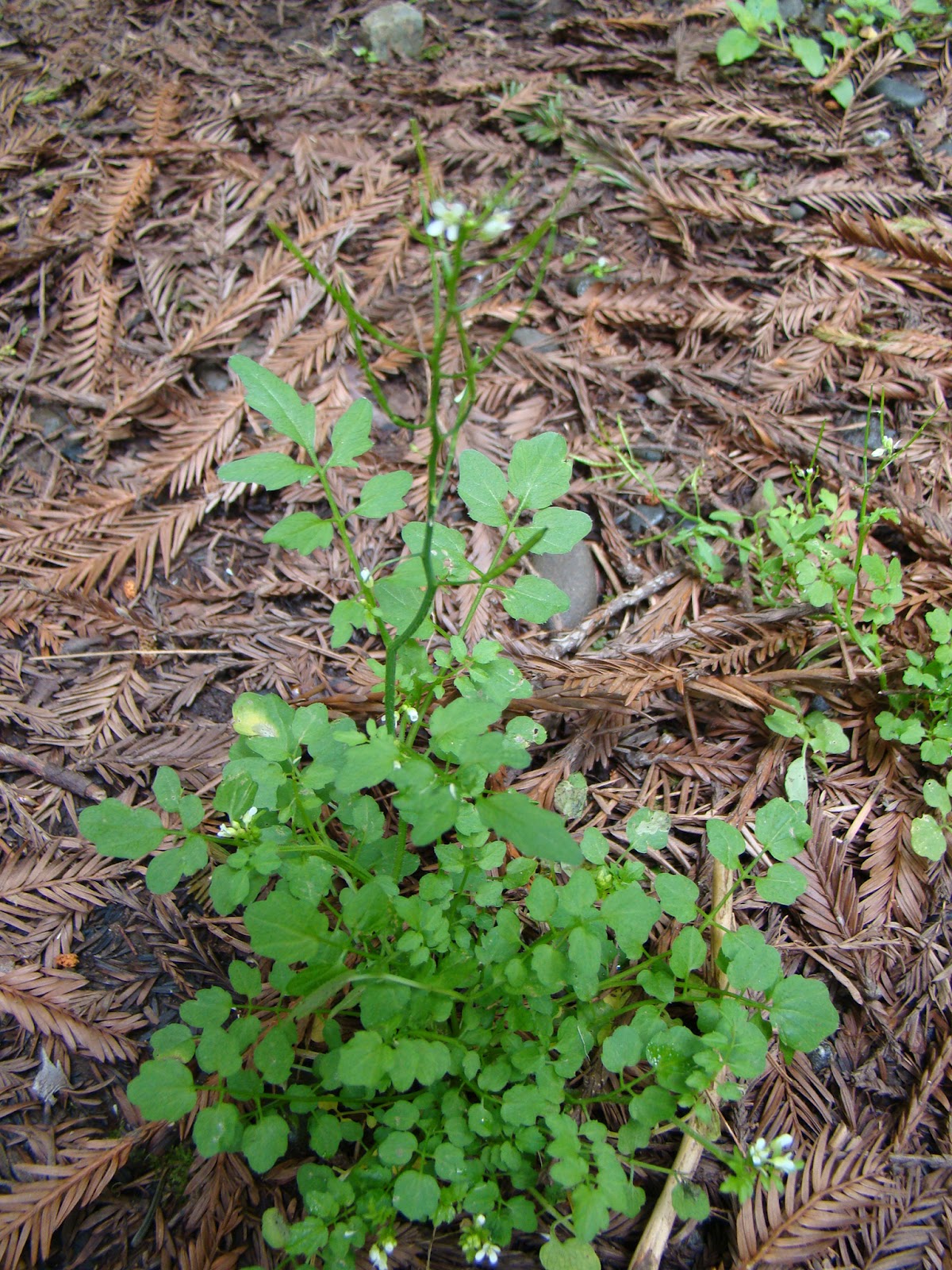
Bittercress

 Bittercress in a forest

Bittercress is a rare plant in the redwood forest. Part of the trouble is that it is extremely small, so unless you are looking for it, it's very easy to miss. Second, it is also inconspicuous. Some plants are small but quite showy. The plant actually perfectly blends with the surrounding vegetation and is hard to spot.

Bittercress (or just cress or cardamine)

The plant definitely belongs to mustard family: it has characteristic 4 petals miniscule flower and the leaves resemble that of watercress. It is most certainly some kind of a cress but I can't pin it down to the genus. I would say it is cardamine hirsuta (hairy bittercress) except it has no hair.